
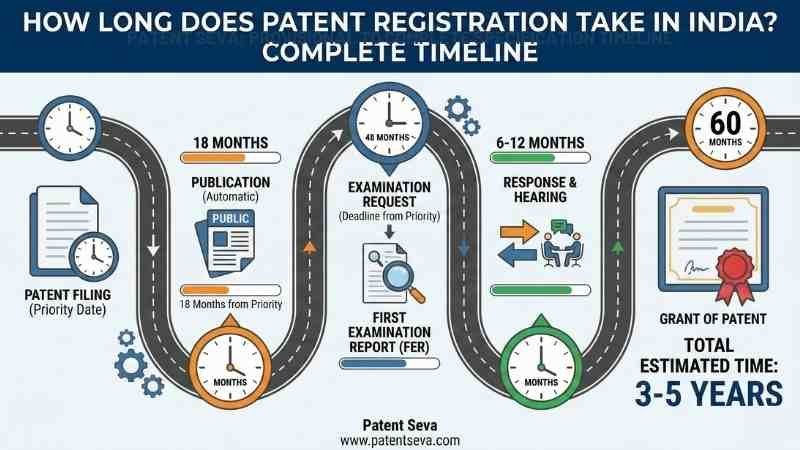
If you’re planning to file a patent in India, one of the first questions you’ll ask is: how long will it take? The answer depends on several factors, including the type of examination you choose and how quickly you respond to the Indian Patent Office.
In this article, we’ll break down the complete patent registration timeline in India in simple language, covering both normal and expedited routes.
Normal Patent Registration Timeline in India
Under the standard process, getting a patent granted in India typically takes 3 to 5 years from the date of filing. However, with recent improvements at the Indian Patent Office and if you respond promptly to all requirements, the timeline can be reduced to around 3 years.
Let’s understand the step-by-step timeline:
Step 1: Patent Application Filing (Day 1)
The process begins when you file your patent application with the Indian Patent Office. You need to submit:
- Complete specification describing your invention
- Claims defining the scope of protection
- Drawings (if applicable)
- Forms and fees
Timeline: 1 day (if filed online)
Step 2: Publication of Application (18 Months)
After filing, your patent application is automatically published after 18 months from the filing date or priority date. This makes your invention public.
If you don’t want to wait 18 months, you can file a request for early publication (Form 9) and get your application published within 1 month.
Timeline: 18 months (automatic) or 1 month (early publication)
Step 3: Request for Examination (Within 31 Months)
As per the Patent Amendment Rules 2024, you must file a Request for Examination (Form 18) within 31 months from the priority date for applications filed after 15 March 2024. For applications filed before this date, the deadline is 48 months.
The patent office will not examine your application automatically. You must request it.
Timeline: Must be filed within 31 months (new rule) or 48 months (old rule)
Step 4: First Examination Report (6-12 Months After RFE)
Once you file the request for examination, the patent office assigns an examiner to review your application. The examiner checks whether your invention meets patentability criteria like novelty, inventive step, and industrial application.
The examiner then issues a First Examination Report (FER) listing objections or prior art found during the search.
Timeline: 6-12 months after filing Request for Examination
Step 5: Reply to First Examination Report (6 Months)
After receiving the FER, you have 6 months to respond to the objections raised. You can request a 3-month extension if needed.
During this stage, you may need to:
- Amend your claims
- Provide clarifications
- Submit additional documents
- Argue why your invention is patentable
Timeline: 6 months (extendable by 3 months)
Step 6: Hearing (If Required)
If objections remain unresolved after your reply, the Controller of Patents may call you for a hearing. This is a discussion where you explain your invention and address concerns.
After the hearing, you’ll need to file a written submission within the given time.
Timeline: Varies (typically 1-2 months for hearing notice)
Step 7: Patent Grant
Once all objections are resolved and the Controller is satisfied, your patent is granted. You’ll receive a patent certificate, and your invention gets legal protection for 20 years from the filing date.
Timeline: 2-6 months after final submission
Total Timeline for Normal Route: 3-5 Years
Expedited Patent Examination Timeline in India
If you need your patent granted faster, India offers an expedited examination option under Rule 24C of the Patents Rules 2003. This can reduce the timeline to just 1 to 1.5 years.
Who is Eligible for Expedited Examination?
Not everyone can apply for expedited examination. You must fall into one of these categories:
- Startups registered under Startup India (DPIIT recognized)
- Small entities or MSMEs with Udyam registration
- Individual inventors (natural persons)
- Women applicants (if one of the applicants is a woman)
- Educational institutions like IITs, NITs, AIIMS, government universities
- Applications where India is selected as ISA/IPEA in PCT filings
- Entities under bilateral agreements with India
Timeline for Expedited Examination
Here’s how the expedited route works:
Step 1: File Request for Expedited Examination (Form 18A)
Along with or after filing your patent application, submit Form 18A requesting expedited examination. You must also file for early publication if your application isn’t published yet.
Timeline: Can be filed anytime before 31 months from priority date
Step 2: First Examination Report (1-2 Months)
Under expedited examination, the patent examiner must examine your application and issue the FER within 1 to 2 months.
Timeline: 1-2 months after request
Step 3: Controller’s Decision (1 Month)
The Controller reviews the examiner’s report within 1 month.
Timeline: 1 month
Step 4: Statement of Objections (15 Days)
You receive the objections within 15 days of the Controller’s decision.
Timeline: 15 days
Step 5: Your Reply (6 Months)
You have 6 months to address objections, with a possible 3-month extension.
Timeline: 6 months (extendable by 3 months)
Step 6: Final Decision (3 Months)
The Controller must issue a final decision within 3 months from receiving your last reply.
Timeline: 3 months
Total Timeline for Expedited Route: 1 to 1.5 Years
This is significantly faster than the normal route and is ideal for inventions with urgent commercial value or time-sensitive markets.
Factors That Affect Patent Timeline
Several factors can speed up or delay your patent registration:
Factors That Speed Up:
- Filing for expedited examination (if eligible)
- Responding promptly to FER
- Having a well-drafted patent application
- Conducting thorough prior art search before filing
- Working with experienced patent agents
Factors That Delay:
- Not filing Request for Examination on time
- Delayed responses to office actions
- Complex objections requiring multiple rounds of clarification
- Poorly drafted applications with unclear claims
- Pre-grant opposition filed by third parties
Cost Difference: Normal vs Expedited
Normal Examination Fees (for individuals/startups/small entities):
- Filing fees: ₹1,600
- Request for Examination (Form 18): ₹4,000
- Early publication (optional): ₹2,500
Expedited Examination Fees (for individuals/startups/small entities):
- Filing fees: ₹1,600
- Request for Expedited Examination (Form 18A): ₹8,000
- Early publication: ₹2,500
The additional cost for expedited examination is ₹4,000 compared to normal examination, but you save 2-4 years in waiting time.
Why Choose Expedited Examination?
Expedited examination is beneficial if:
- Your invention has a short commercial window
- You need patent protection to raise funding from investors
- Competitors might enter the market soon
- You want to license your patent quickly
- Your industry moves fast (like software, electronics, biotech)
For large companies, the expedited examination fee is higher (₹60,000), but it’s still worth it considering the competitive advantage of early patent grant.
Important Points to Remember
- File RFE on time: If you miss the deadline (31 or 48 months), your application will be considered withdrawn.
- Respond quickly: The faster you respond to office actions, the quicker your patent gets granted.
- Prior art matters: A thorough patentability search before filing helps avoid objections later.
- Professional help: Working with registered patent agents ensures your application is drafted correctly and speeds up the process.
- Publication is mandatory: Your application must be published before examination begins.
- Patent protection starts from filing date: Even though the grant takes time, your patent protection is calculated from the filing date, not the grant date.
Get Your Patent Registered Faster with Patent Seva
At Patent Seva, we help inventors, startups, and businesses across India get their patents registered efficiently. Our team of experienced patent agents understands the Indian patent system inside out.
Our Services Include:
- Complete patent filing and prosecution
- Prior art search and patentability analysis
- Patent drafting by technical experts
- Fast-track expedited examination (if eligible)
- Handling First Examination Reports and objections
- End-to-end support until patent grant
Why Choose Patent Seva?
✓ Transparent pricing with no hidden costs
✓ Expert team of patent agents and scientists
✓ Coverage across all technical fields
✓ Serving clients across India
✓ Government subsidy assistance for startups
Ready to protect your invention?
Contact us today for a free consultation and let us guide you through the patent registration process.