
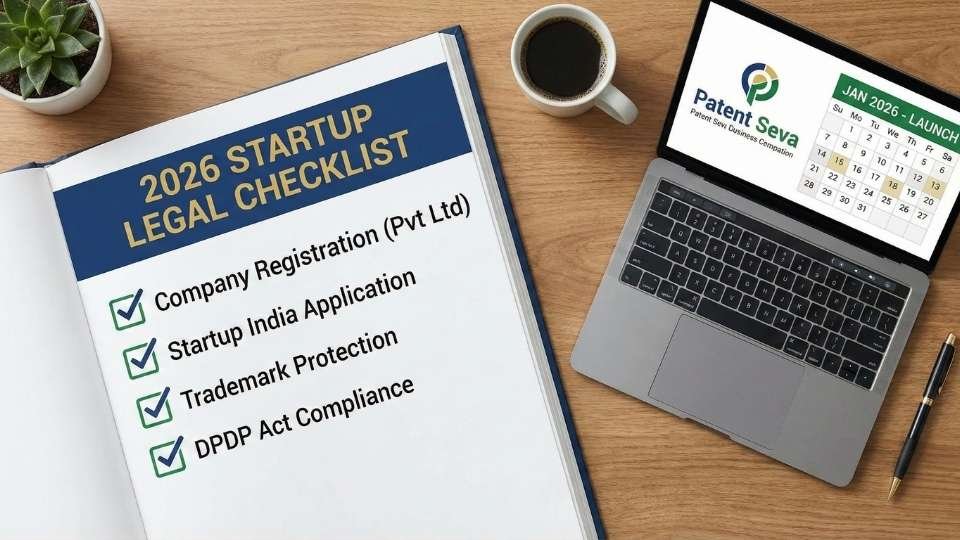
The New Year is the most popular time to launch a business in India. If you are reading this, you likely have a business idea, a vision, and the drive to succeed in 2026.
But passion alone doesn’t build an empire—solid legal foundations do.
As we enter 2026, the legal landscape for Indian startups has evolved. It is no longer just about getting a PAN card. With new Data Protection Laws and Startup India benefits, you need a modern strategy.
At Patent Seva, we have helped hundreds of founders transition from “Idea” to “Incorporated Company.” Here is the ultimate legal checklist to ensure your 2026 launch is flawless.
Choose Your Structure (The Foundation)
Before you spend a single rupee on a logo, you must decide your legal structure. This decision affects your taxes, liability, and ability to raise funding.
-
Private Limited Company (Pvt Ltd): The gold standard for startups. If you plan to raise investment or give ESOPs to employees, this is mandatory.
-
Limited Liability Partnership (LLP): Best for service-based businesses (like agencies or consultants) who want lower compliance costs but still want liability protection.
-
One Person Company (OPC): Ideal if you are a solo founder but want a formal corporate structure.
The “Digital” Paperwork (Immediate Action)
In 2026, you don’t need to visit government offices. Everything is digital.
-
DSC (Digital Signature Certificate): You cannot sign company documents with a pen anymore. You need a crypto-token based digital signature.
-
DIN (Director Identification Number): A unique ID for you as a director.
-
Name Reservation (RUN Service): Check if your business name is available on the MCA (Ministry of Corporate Affairs) portal. Tip: Do this before buying the domain name!
The “Startup India” Advantage
This is where you save money. Registering under the Startup India Scheme is not just a badge of honor; it is a financial strategy.
-
80% Rebate on Patents: If you have an invention, the government pays 80% of your patent filing fees.
-
50% Rebate on Trademarks: Protect your brand name for half the cost.
-
Tax Holidays: Eligible startups can apply for a 3-year income tax exemption (Subject to Inter-Ministerial Board approval).
The New Compliance for 2026 (Vital Update)
Unlike older checklists, you must now consider the Digital Personal Data Protection (DPDP) Act. If your new business collects customer data (names, phone numbers, emails) via a website or app, you are legally a “Data Fiduciary.”
-
Consent Managers: Your website must have proper cookie consent mechanisms.
-
Privacy Policy: You need a drafted privacy policy that complies with the new 2025-2026 rigorous standards.
Brand Protection (Don’t Skip This)
Imagine launching in January 2026 and receiving a legal notice in March asking you to change your name. It happens more often than you think.
-
Trademark Filing: File your brand name immediately after incorporation.
-
Copyright: If you sell courses, software, or unique designs, copyright them to prevent copycats.
Conclusion
Starting a business is exciting, but the legal paperwork can be overwhelming. The good news? You don’t have to do it alone. By ticking off these boxes early in 2026, you ensure that your focus remains on growth, not on fixing legal errors.
Ready to Launch Your Dream Business in 2026? Don’t get lost in the paperwork. At Patent Seva, we offer a complete “Startup Launch Package” that covers everything from Company Incorporation to Trademark Filing.
Contact US!
-
Call/WhatsApp: +91 7807205357
-
Email: contact@patentseva.com
-
Book an Appointment: Contact Us