
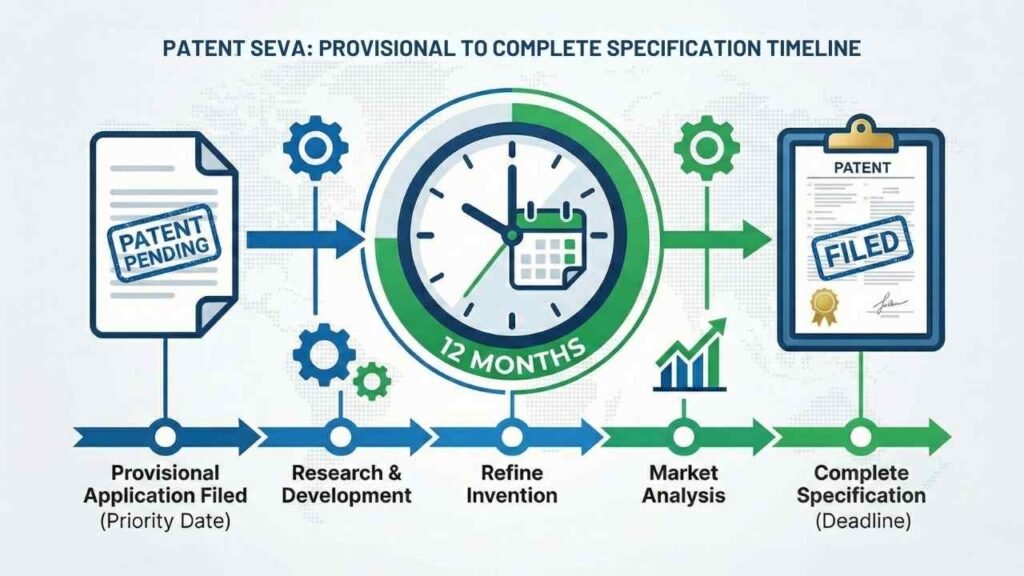
A provisional patent application in India is a cost-effective tool for inventors and startups to establish an early priority date while their invention is still under development. Filed with the Indian Patent Office under Section 9 of the Patents Act, 1970, it provides 12 months to refine your invention and assess commercial viability before filing a complete specification. This guide explains everything you need to know about provisional patent filing in India.
What is a Provisional Patent Application?
A provisional patent application is a preliminary filing with the Indian Patent Office that establishes an official priority date for your invention. According to Indian patent law, a provisional specification should contain the title and description of the invention and must start with the preamble “The following Specification describes the invention.”
This filing type is used when your invention is still in the experimentation or development stage but has reached a point where it can be described on paper. It’s not a patent itself—you must file a complete specification within 12 months to continue the patent process, or your application will be deemed abandoned.
Key Benefits of Filing Provisional Specification
Establish Priority Date
By filing a provisional specification, you establish a priority date that protects your invention from information leakage during the R&D phase. If someone else files a similar patent application after your provisional filing date, your earlier priority date gives you an advantage.
Lower Initial Cost
The filing fees are significantly affordable. For individuals, startups, small entities, and educational institutions, the fee is ₹1,600, while large entities pay ₹8,000. This is much lower than the total cost of pursuing a complete specification with examination fees.
Patent Pending Status
Once filed, you can legally use “patent pending” or “patent applied for” on your product. This warns competitors, attracts investors, and signals that your innovation has intellectual property protection in process.
12-Month Development Window
The provisional specification provides 12 months to further develop, refine, and assess the commercial viability of your invention before filing a complete patent application. This time allows you to build prototypes, test markets, secure funding, and determine if your invention justifies the higher costs of a complete specification.
Simpler Requirements
A provisional specification may or may not contain claims and is not necessary to include formal claims. You don’t need detailed technical drawings or extensive prior art searches at this stage, making it accessible for individual inventors and startups.
What You Need to File
Form 1: Application for Grant of Patent
Form 1 is the application form that accompanies your specification. It includes the invention title, applicant and inventor details, declaration of inventorship, address for service in India, and details of patent agent if filing through one (with Form 26 – Power of Attorney).
Form 2: Provisional Specification
Form 2 contains your provisional or complete specification as per Section 10 and Rule 13 of the Indian Patents Act, 1970. Your provisional specification must include a clear description enabling someone skilled in your field to understand the invention, details of what the invention is and how it works, the problem it solves, its components and materials, and optional drawings or diagrams if necessary to understand the invention.
The description should start from the second page, starting with the field of invention and containing the background of the invention, object of the invention, and detailed description.
Important Note on Claims
While formal claims are not mandatory in provisional specifications, including a few broad claims can help focus your description and provide stronger priority support later.
Filing Process Step-by-Step
Step 1: Conduct Patent Search
Before filing, search existing patents using the Indian Patent Office search portal, Google Patents, and international databases to ensure your invention is novel. This prevents wasting money on non-patentable ideas.
Step 2: Prepare Your Specification
Write a comprehensive description of your invention for Form 2. Include what it is, how it works, its components, what makes it unique, materials and methods used, and multiple examples or variations. Create clear drawings or diagrams illustrating key features.
Step 3: Determine Your Entity Status
Identify if you’re an individual, startup (with Startup India registration), small entity, educational institution (paying ₹1,600), or large entity (paying ₹8,000). Most independent inventors and startups qualify for the reduced fee.
Step 4: Complete Required Forms
Fill out Form 1 (Application for Grant of Patent) and Form 2 (Provisional Specification). If filing through a patent agent, prepare Form 26 (Power of Attorney). Ensure all information is accurate with proper addresses and jurisdiction.
Step 5: File Electronically
Use the Indian Patent Office e-filing portal at ipindiaonline.gov.in. Register for an account, select “File New Application,” upload Form 1 and Form 2 with attachments, complete payment online, and submit. You’ll receive an acknowledgment with your application number immediately.
Step 6: Calendar the Deadline
Any application accompanying a provisional specification is deemed to be abandoned if no complete specification is filed within twelve months from the date of filing of the provisional specification. This deadline is absolute with no extensions. Set multiple reminders at 9, 10, 11, and 11.5 months.
Filing Costs in India (2025)
Government Fees
For provisional specifications with Form 2 (up to 30 pages): ₹1,600 for individuals/startups/small entities/educational institutions, ₹8,000 for large entities. For extra pages beyond 30: ₹160 per 50 pages (individuals/startups/small entities), ₹800 per 50 pages (large entities).
Professional Fees
Patent attorney or agent fees range from ₹4,000 to ₹25,000, depending on complexity. Simple mechanical inventions cost ₹5,000-₹12,000, software/electronics inventions cost ₹10,000-₹20,000, and complex biotech/pharma inventions cost ₹15,000-₹25,000.
For review and editing of self-drafted specifications, expect ₹3,000-₹8,000.
Total Investment
DIY filing costs ₹1,600-₹8,000 (government fees only). With professional help, expect ₹6,600-₹33,000 total.
Critical Mistakes to Avoid
Insufficient Detail
The most common error is providing too little detail. Anything not adequately described in your provisional specification won’t receive the benefit of the provisional’s priority date. When in doubt, include more detail rather than less.
Missing the 12-Month Deadline
This deadline is absolute with no extensions. Missing it means your application is abandoned and you lose all priority benefits. Set multiple calendar reminders.
Public Disclosure Before Filing
File your provisional specification before any public disclosure, product launch, or publication. While India offers some grace periods, public disclosure before filing can jeopardize international patent rights.
Assuming Patent Pending Provides Legal Rights
Patent pending status doesn’t give you enforceable rights. You cannot take legal action against infringers until a patent is actually granted.
Filing Too Early
If you file before your invention is reasonably developed and then make significant changes, those changes won’t be covered by your provisional’s priority date.
Converting to Complete Specification
If a provisional specification is filed initially, a complete specification must be filed within 12 months to maintain priority. You can file anytime within this window—most inventors file near the end to maximize development time.
What the Complete Specification Requires
Your complete specification must include formal patent claims defining your invention’s scope, comprehensive description enabling someone skilled in the art to make and use the invention, formal drawings if necessary, and an abstract (150-200 words). The complete specification builds upon your provisional but cannot add completely new matter.
Claiming Priority
In Form 1 of your complete specification, include your provisional application number and filing date to claim priority. The term of patents filed in India is 20 years from the date of filing, irrespective of whether the application for the patent is accompanied by a provisional specification or a complete specification.
This means your patent term starts from your provisional filing date, not your complete specification filing date. If you file a provisional on January 1, 2025, and a complete on December 31, 2025, your patent expires January 1, 2045 (20 years from provisional date).
Multiple Provisionals
You can file multiple provisional specifications for improvements made during the 12-month period, then file one complete specification claiming priority from all of them.
Important Restrictions
A provisional specification cannot be filed in case of a Divisional, Convention or a PCT National Phase Application. In such cases, filing a complete specification is a mandatory requirement.
Provisional vs Complete Specification
Provisional Specification: Never examined by IPO, no formal claims required, 12-month validity (no extensions), costs ₹1,600-₹8,000, doesn’t result in granted patent, simpler requirements, ideal when invention is under development.
Complete Specification: Fully examined for patentability, requires formal claims, remains pending until examination complete (2-4 years), costs ₹1,600-₹8,000 for filing plus ₹4,000-₹20,000 for examination request (Form 18), can result in a granted patent, requires comprehensive disclosure, necessary when invention is fully developed.
When to Hire a Professional
Consider hiring a registered patent attorney or Patent Agent if your invention is technically complex, you’re seeking significant investment, competitors are active in your field, you want international protection, you’re uncertain about what to include, or the potential commercial value justifies the investment.
Professional fees range from ₹4,000-₹25,000 but can prevent costly mistakes. Many offer free initial consultations (₹500-₹2,000) to discuss your invention and provide fee estimates.
Conclusion
A provisional patent application is a powerful tool for protecting inventions in India during their development phase. For just ₹1,600, you can establish an early priority date, gain patent pending status, and secure 12 months to refine your invention and assess market viability before committing to a complete specification.
However, success requires thorough documentation, meeting the absolute 12-month deadline, and understanding that the patent term starts from your provisional filing date. Whether filing yourself or with professional help depends on your invention’s complexity and commercial potential.
Start your patent protection journey today by documenting your invention thoroughly and filing with the Indian Patent Office. Remember, the patent term is 20 years from the date of filing irrespective of whether the application is accompanied by a provisional or complete specification, so plan your filing strategy carefully to maximize both protection and patent term.